Site Header


Art by KyleEugeneSnyder
Start dreaming and create with AI
Get 10 weekly prompts free!




Description
The Treasure of the Maharash — Historical Profile
Name: Treasure of the Maharash
Location: Underground chamber of the ancient royal palace, Cold Lairs (Lost City)
Status: Hidden and protected
Guardian: Whitethou, the albino cobra
Value: Incalculable (described as “three times richer than a king with only a handful of coins”)
Significance: Historical, religious, and mythological resource; trigger for human wars; cursed element for the animals of Seoni
Overview
The Treasure of the Maharash is one of the greatest accumulations of wealth ever amassed by any human civilization in the history of the Indian subcontinent. It lies hidden in a magnificent circular underground chamber, located deep within the ruined palace of Cold Lairs. For over two millennia, the treasure has remained untouched, protected from the outside world, and has become a universal legend.
The magnitude of its wealth surpasses modern imagination. For the animals of Seoni, it is a cursed relic, the source of death, greed, and destruction. For humans, it is an irresistible myth that has haunted explorers, empires, conquerors, and criminals for centuries.
Historical Origins
Pilgrimage and Accumulation
For centuries, the ancient city—then a prosperous kingdom—received visitors from all over Asia. It was a spiritual, political, and commercial center, and thousands of pilgrims came to worship the local gods.
Each traveler left monetary offerings seeking to “purify their soul,” which in contemporary terms could be summarized as:
“Giving a little something to buy your way into Heaven.”
These donations, combined with tribute from vassals, trade, and the mineral wealth of the region, led to a progressive and monumental accumulation of coins, jewels, and artifacts.
The Treasure War (544 BCE)
This prosperity aroused the greed of a neighboring kingdom. Eager to seize the underground vault and its riches, they invaded the city. What followed was a massacre:
the walls burned,
the streets ran red with blood,
and the entire population was wiped out.
No one survived.
No one claimed the loot.
And the treasure remained forever locked beneath the ruins.
For the animals who lived through that tragedy—especially Whitethou—it was proof that gold was cursed and that humans would be capable of destroying everything in their path.
The Treasury Hall — Detailed Description
The underground vault is a majestic, almost sacred space, described as follows:
Architecture
A huge circular hall with natural acoustics.
Red columns with large Indo-Persian arches.
Around the hall, colossal statues of Hindu gods:
Shiva
Ganesha
Maa Durga
Hanuman
Krishna
A C-shaped water channel, fed by jets of water emanating from carved cobra statues.
Decoration
Ancient frescoes covering the walls.
Partially preserved, dusty tapestries.
Stone torches, extinguished for centuries.
A central pedestal supported by sculpted elephants.
The Treasury
The chamber is literally overflowing with riches:
Millions of coins (gold, silver, bronze).
Jewels and precious stones:
diamonds, sapphires, rubies, emeralds, pearls.
Noble objects:
Vases
Candelabras
Cutlery
Statues
Ornaments and bracelets
Lamps and ritual vessels
Chests and jars overflowing with even more riches.
For a human, it's a fortune of a hundred lifetimes.
For an animal, they are useless objects with no scent of food.
Animal Interpretation: The Curse of Greed
Whitethou and other animals who have inherited the memory of the tragedy consider this treasure corrupt. From their perspective:
gold does not nourish,
it does not provide shelter,
it does not protect,
it only provokes wars.
It is an abstract concept they will never be able to understand, except as a source of human destruction.
Whitethou defines it thus:
“This treasure belongs to man… and it is from man that I protect it.”
For him, preventing it from falling back into human hands means protecting the entire jungle.
The Myth in the Human World
For centuries, the legend of the Maharaja's Treasure has spread like an irresistible echo. Among those who sought it—or tried to—are:
Alexander the Great
Julius Caesar
Attila the Hun
The Knights Templar
The British Empire
Napoleon Bonaparte
Nazi archaeological teams during World War II


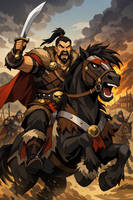


None succeeded. None returned with proof.
The Seoni jungle always won.
Buldeo's Obsession
The last—and most dangerous—of the obsessed is Buldeo John Lockwood. For him, finding the treasure is not a dream: it is his destiny. He has sacrificed years, fortunes, and lives pursuing this ancient legend, and he considers the Seoni jungle his territory and his prize.
He wants to possess it at any cost.
He is willing to raze the entire jungle to achieve it.
And he is the only human who poses a real threat to the subterranean chamber.
Symbolism of the Treasure
The Maharaja's Treasure embodies:
human greed and its cyclical violence,
the fragility of civilizations,
the arrogance of empires,
blind faith in material things,
and, in contrast,
animal wisdom, which sees no value in what does not nourish or sustain life.
It is a powerful narrative device:
an eternal reminder that even the most glorious kingdoms can fall by wanting too much.


There's only one way to search for buried treasure in an Indian jungle: metal detectors. 
