Site Header
Deviation Actions


Art by elfdame
Start dreaming and create with AI
Get 10 weekly prompts free!


Description
How Fear Came About
Traditional Tale from the Seoni Jungle
Type: Cultural narrative / foundational myth
Transmission: Oral, passed down from generation to generation
Usual narrator: Hathi
First narrative appearance: During the first Water Truce experienced by Mowgli (at age 10)
Veracity: Unknown (considered a legend, not a historical record)
General description
“How Fear Came About” is one of the oldest and most solemn tales from the Seoni Jungle. For the animals, it serves the same purpose as the great origin myths do for humans: it explains why the world is the way it is, why predation, conflict, and above all, fear exist.
It is not told lightly. It is only recounted in exceptional moments, when the jungle is going through profound crises, such as during a Water Truce. It is a story that seeks not to entertain, but to remind.
The Age of Peace
According to legend, in ancient times—vaguely placed in the Cenozoic era—the jungle lived in perfect balance. There was no fear between species, and conflicts were rare.
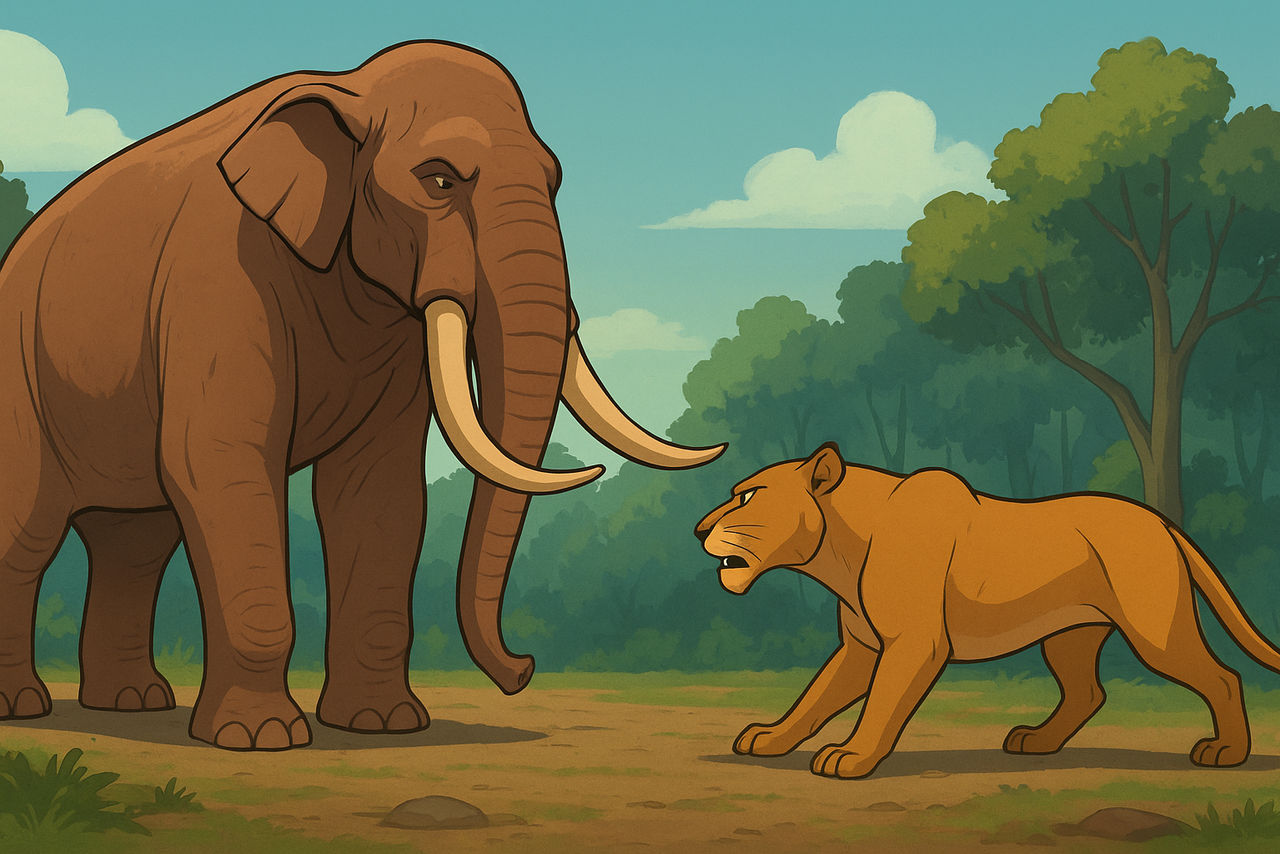
The sovereign of the jungle was Tha, a great elephant, wise and powerful. However, his size and responsibilities prevented him from attending to every minor dispute. To maintain peace, he appointed a tiger named Shaluk as judge, imposing two sacred rules upon him:
To resolve disputes with neutrality.
Never to hunt those who came to him seeking justice.
The Fall
One day, two deer came to Shaluk with a trivial dispute. They insisted, complained incessantly, pressured him… until the tiger, overcome by rage, killed them.
The crime devastated him. He fled in terror, wandering aimlessly through the jungle. During his escape, the undergrowth tore at his fur, leaving marks on his body. Legend holds that these scars were the origin of the tiger's stripes, an eternal mark of guilt, likened by the animals to the mark of Cain.
The Birth of the Law
Tha witnessed the murder and understood something terrible:
peace was over.
To prevent total destruction, he created the Law of the Jungle, a set of rules designed to allow prey and predators to coexist in a world where fear already existed.
Before leaving, Tha issued a cryptic warning:
“Beware of Fear.”
The animals believed he was referring to a creature.
The True Fear
Searching for this threat, a group of buffalo discovered something never before seen:
a creature without hair, feathers, or scales, that walked on two legs.
It was the first human to arrive in Seoni.
Shaluk, desperate to redeem himself, decided to confront it. He killed the human, believing he had destroyed Fear and saved the jungle.
But Tha appeared one last time…
and publicly accused him:
Of having killed the deer.
And now, of having started the war between humanity and nature.
According to the legend, by killing the human, Shaluk did not eliminate Fear:
he taught humans how to kill.
Symbolic Meaning
The story explains:
The origin of fear between species.
The birth of organized predation.
The reason for the Law of the Jungle.
And the irreparable relationship between humans and animals.
For many elders, the true “Fear” is not the human…
but what it awakens in others.
Relevance to Mowgli
When Hathi tells this story to Mowgli, it is no coincidence. The boy represents a living paradox:
human by birth, animal by upbringing.
The story poses an uncomfortable question that hangs in the air:
If fear came with humankind…
what happens when a person grows up without fear?
And that's where it all begins.
Wow, Shere Khan’s ancestor looks like a lioness but after he killed the deer not for food and the first Man, the vines marked him and the rest of his species that continued on to be their stripes.