Site Header

Deviation Actions


Promoted Deviations


Suggested Deviants


Suggested Collections





Description
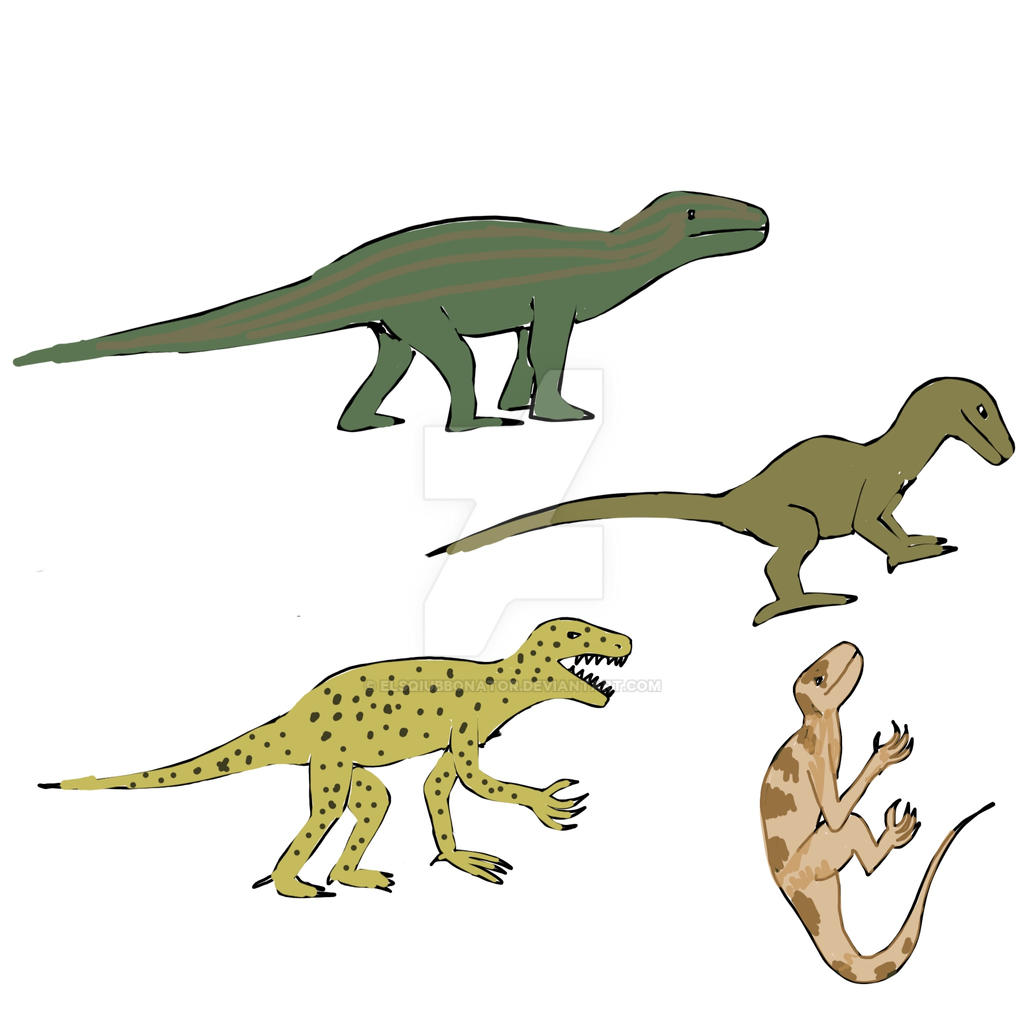
In the late Neozoic, 100 million years in the future, squamates rule the Earth. Hundred-foot-long seasnakes are the largest animals in the world at this time, and lizards of every shape and size are an important part of most terrestrial ecosystems. One of the dominant groups of large predators on the supercontinent of Polaria (so named because part of it covers the North Pole) is the Pinchers (family Ailurolacertidae), a family descended from monitor lizards which are the primary ambush predators in most temperate and tropical regions. Pinchers are endothermic, unlike lizards today, and as such they are able to withstand much colder temperatures. They also walk with their legs fully erect and their bodies off the ground, while their tails are carried in the air.
The Meganesian Pincher (Ailurolacerta gracilis) is a fairly typical member of this group, found in the dry scrub forests of what was once Australia. About the size of a leopard, it is the top predator of this region, relying on stealth rather than speed to ambush the large flightless birds that are its main prey. Like all Pinchers, it gives birth to live young, and no longer lays eggs. However, it is quite a proficient predator of the eggs of ground-nesting birds, which it easily crushes in its powerful jaws before consuming their contents.
The Desert Dragon (Ailurolacerta deinognathus) is the northernmost species of Pincher, found in the Sahara. It is also a fairly small one, about six feet long including its tail, and it is unusual in being nocturnal in order to avoid the blistering heat of the desert. This is in stark contrast to desert-dwelling reptiles today, which are typically diurnal and sleep at night to avoid the cold. The Desert Dragon's prey consists not only of smaller reptiles and birds, but also large arthropods such as scorpions.
While monitor lizards were only found in Africa, Asia, and Australia, Pinchers have spread around the world. The largest of all Pinchers is the Steppe Pincher (Varanodromaeus ferocidens), which can grow as large as a tiger and is equally aggressive. The Steppe Pincer lives in South America, hunting the only prey that can sustain it-- the giant, herbivorous fence lizard descendants called Bordas. These lizards can weigh up to 10 tons, and are quite capable of self-defense, so the Steppe Pincher normally targets their juveniles, which are much smaller and more vulnerable.
On the other extreme, the smallest species of Pincher is the Tree-leaper (Arbolacerta lemuriensis), a stealthy hunter no bigger than a housecat. Stalking through the treetops in tropical Africa, it is a specialized predator of bats, which have displaced birds as the dominant flyers of this era. Catching flying animals is difficult, but the Tree-leaper is agile enough to knock its victims out of the air, and silent enough to sneak up on them as they roost.
Image size
2048x2048px 300.28 KB
© 2021 - 2026 ElSqiubbonator
Comments0
Join the community to add your comment. Already a deviant? Log In