Site Header

Deviation Actions


Description
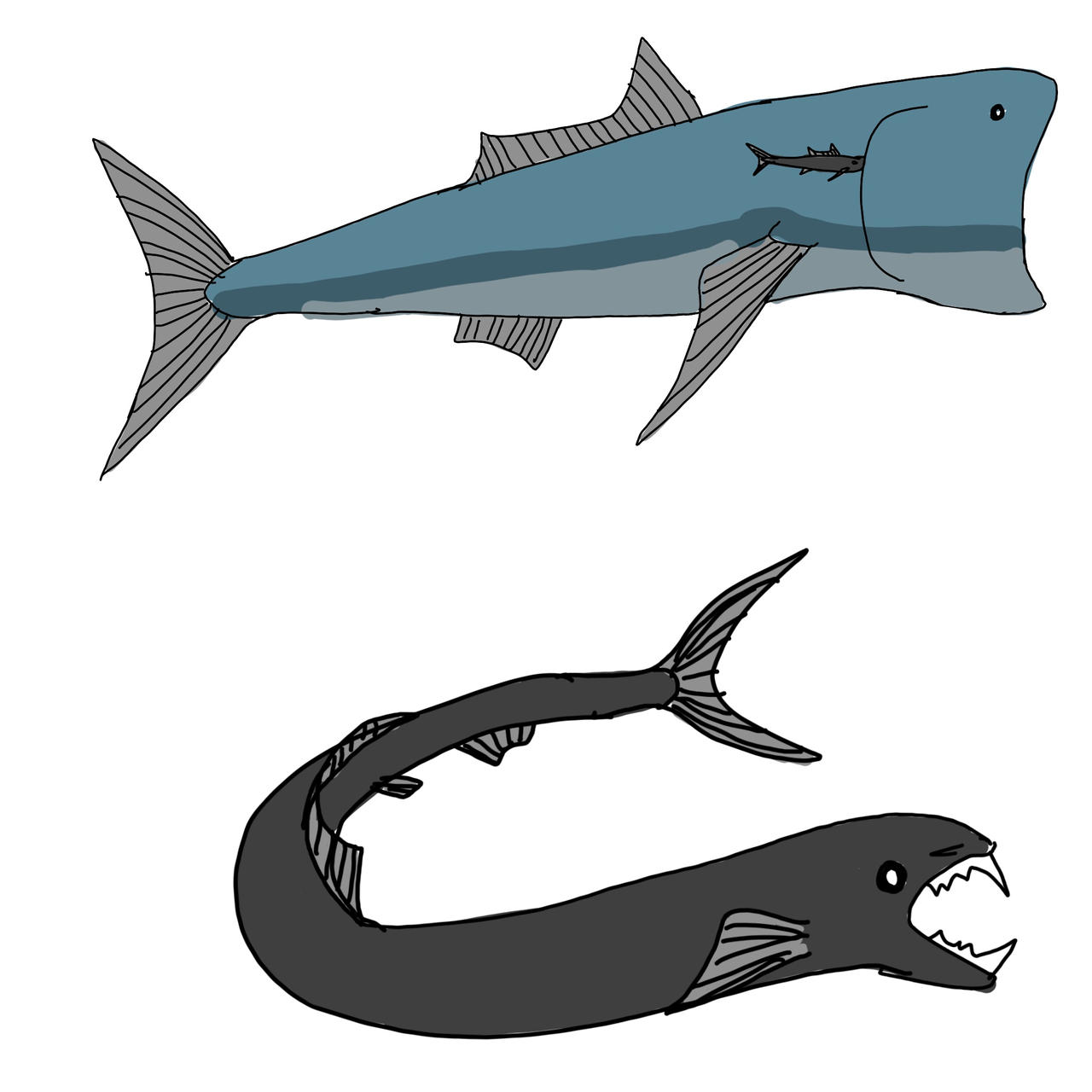
Despite having existed since the Triassic period, the marine reptiles have never evolved filter-feeding forms. Instead the enormous Bloops, fish related to the predatory ichthyodectids, are the dominant filter-feeders. Growing up to 50 feet long and weighing over 40 tons, Bloops are among the largest creatures in the ocean. But one of their most persistent enemies is much smaller.
The Nosferatuna (Vampyrichthys lythrotomus) is an ichthyodectiform, and therefore a distant relative of the giant Bloops, despite being only two feet long. This fish, however, has evolved the opposite lifestyle. Rather than filter-feeding on schools of tiny crustaceans, it feed on animals hundreds of times larger than itself. Using its sharp, pointed teeth, it bites a chunk out of the gill tissue of a Bloop, or other large fish, then lodges itself in the bigger fish's gills to feed on its blood.
A Nosferatuna may remain wedged inside a Bloop's gills for days, relying on its host's forward motion to keep water flowing over its own gills. The Bloop, of course, is not a passive participant in this; Bloops will often thrash about, and even leap out of the water, to dislodge their unwanted hitchhikers, but the Nosferatuna's sharp teeth keep it firmly attached. After a while, though, it will let go and swim off to find another host.
Like all members of the ichthyodectiform group, the Nosferatuna lays its eggs in the open sea, where they float on the surface before hatching into microscopic larvae. Most of these larvae are eaten by predators long before they mature.