Site Header
 bagera3005 on DeviantArthttp://creativecommons.org/licenses/by/3.0/https://www.deviantart.com/bagera3005/art/Lockheed-EFX-70-Panther-VFA-151-Vigilantes-1272414181bagera3005
All Images
Deviation Actions


Badge Awards
Description
Lockheed Martin EFX-70 Panther II
Role
Air superiority fighter / Multirole combat aircraft
National origin
United States
Manufacturer
Lockheed Martin (Skunk Works Division)
First flight
May 15, 2020
Introduction
March 1, 2024 (Initial Operational Capability)
Status
In active service
Primary users
United States Navy • United States Marine Corps
Produced
2022–present
Number built
65 (of 250 planned)
Program cost
Classified
Unit cost
≈ US $250 million
Overview
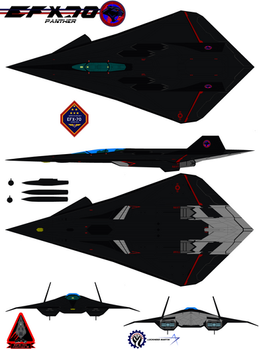
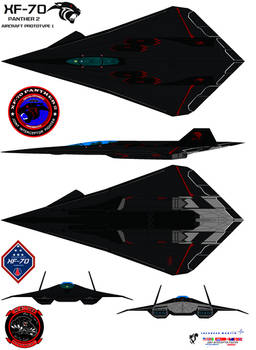
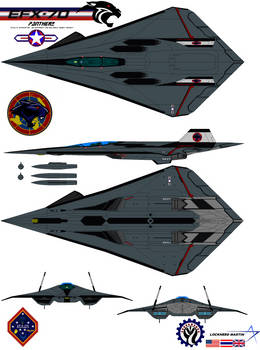
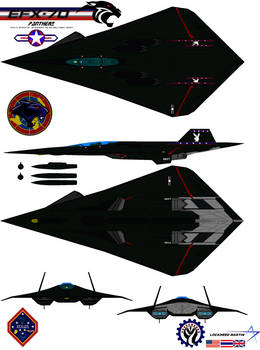
The Lockheed Martin EFX-70 Panther II is a family of single- or twin-seat, twin-engine, all-weather, sixth-generation stealth fighters developed by Lockheed Martin’s Skunk Works for the United States Navy and Marine Corps under the Next Generation Air Dominance (F/A-XX) program.
A successor to the F-22 Raptor and complement to the F-35 Lightning II, it excels in air superiority and multirole missions, including electronic warfare, deep strike, and manned-unmanned teaming (MUM-T) with 4–8 Collaborative Combat Aircraft (CCAs).
Featuring hypersonic propulsion, plasma stealth, AI-assisted brain-computer interface (BCI) controls, and directed-energy weapons, the Panther II was engineered to defeat next-generation threats such as China’s J-36 and Russia’s Su-57M.
Variants include the air-superiority/multirole EFX-70A, dedicated air-superiority FA-70B, electronic-warfare EF-70C, and deep-strike FB-70D models.
It replaces the F/A-18E/F Super Hornet and operates alongside the F-35C in Navy service.
Development
Background
Launched in 2016 under the NGAD program, the EFX-70 was conceived to counter Indo-Pacific threats including hypersonic missiles and sixth-generation fighters. Lockheed Martin combined the F-22’s stealth and the F-35’s sensor fusion, targeting Mach 5–8 performance, a radar cross-section of ≈ 0.00001 m², and neural BCI latency under 0.1 s. The XF-70 demonstrator was selected in 2019 for its dual-mode ramjet/scramjet engines and plasma-stealth capability.
Design Phase
Between 2018 and 2020, Skunk Works performed 20,000 hours of wind-tunnel and CFD testing at Palmdale, California. The airframe used 3D-printed ceramic matrix composites and graphene thermal coatings for hypersonic durability. Adaptive-cycle engines and a modular escape pod replaced traditional ejection systems.
Prototypes and Testing
Engineering and manufacturing development began in 2020; the XF-70 flew on May 15, 2020, achieving Mach 5 super cruise and neural BCI control. The EFX-70A prototype debuted in 2021 at Marietta, Georgia. Testing at China Lake and Edwards AFB amassed 4,000 flight hours by 2024, proving cryogenic nozzle cooling (<200 °C) and AI-driven avionics integration (over 2 million lines of Python/Ada code).
Production
Low-rate initial production began in 2022 with 65 aircraft built by October 2025 (out of 250 planned by 2050). Unit cost is ≈ US $250 million. Initial Operational Capability (IOC) was declared on 1 March 2024 with VFA-147 at NAS Lemoore.
Milestones
2022 – First firing of the GER-70T electromagnetic railgun
2023 – MUM-T demonstration with CCAs
2024 – Sub-orbital strike capability validated
Design
Airframe and Layout
Faceted diamond-wing planform optimized for hypersonic lift-to-drag and low observability; graphene thermal coatings and CMCs resist Mach 8 temperatures. Modular structure permits future upgrade paths and CCA control.
Powerplant
Engines: 2 × Lockheed Martin adaptive-cycle turbofans (50,000 lbf dry, 65,000 lbf AB) with dual-mode ramjet/scramjet boost for Mach 5–8.
Fuel: 25,000 lb internal (11,340 kg). AI manages flow for up to 19,600 mi combat radius or 25,000 mi ferry range with refueling.
Performance: Super cruise Mach 2.5 +, sub-orbital to 150,000 ft, climb rate ≈ 58,000 ft/min.
Stealth and Counter-Detection
RCS ≈ 0.00001 m² (base airframe); < 0.000002 m² for weapons bays and GER-70T.
Plasma stealth layer and micro-LED adaptive camouflage.
Cryogenic cooling for infrared masking (<200 °C).
Avionics Suite
Radar: AN/APG-91 AESA with quantum augmentation (200 mi range, 150 targets).
Sensors: AN/AAQ-45 Distributed Aperture System; AN/AAQ-50 EOTS (10 m CEP @ 3 km).
EW: AN/ASQ-250 broadband (1–100 GHz jamming).
Cockpit: Neural BCI helmet (<0.1 s latency), holographic HMDS, voice and haptic redundancies.
Armament
Fixed Weapons
2 × Lockheed Martin GER-70T electromagnetic railguns (1,000 smart darts, Mach 7–8, 5–50 km range, 80–240 rpm).
Internal Weapons Bays
Nose bay: GER-70T magazine (1,000 rounds).
Forward bay: 4–6 stations (6 × AIM-260 JATM possible).
Mid bays: 4–6 stations each (typ. AIM-132 ASRAAM or AIM-120C AMRAAM).
Aft ventral bay: Pike Missile Countermeasure/Decoy Pod (6–8 Pike interceptors + chaff/flares).
Side bays: 2 × AIM-9X Sidewinder.
External Hardpoints
4 × wing pylons (RCS ≈ 0.0001 m²) for AGM-183A ARRW or Storm Shadow missiles, or strike pods.
Ordnance Compatibility
AIM-260 JATM • AIM-132 ASRAAM • AIM-9X Sidewinder • AGM-154 JSOW • Brimstone • GBU-12/31/39 LGB/JDAM/SDB • CBU-103/105 WCMD • AGM-158 JASSM • AGM-88 HARM • Mk 82/83/84 GP • nuclear B61/B83 (dual-capable option).
Directed-Energy
Lockheed Martin 50 kW solid-state laser (100 kW upgrade projected 2050).
Operational History
Entered active service 2024, performing air-superiority, hypersonic intercept, and sub-orbital strike missions. By Oct 2025 the fleet had 12,000 flight hours, 95 % mission-capable rate, and 12 : 1 kill ratio in Red Flag exercises.
United States Service
2024 – IOC with VFA-147 (NAS Lemoore).
2025 – Deployed to Guam; defeated J-36 drone swarms in joint tests.
Variants
EFX-70A: Baseline multirole / air superiority (40 built).
FA-70B: Enhanced air superiority (15 built).
EF-70C: Electronic warfare variant (5 built).
FB-70D: Deep-strike sub-orbital (5 built).
XF-70: Technology demonstrator (retired).
Operators
United States Navy – NAS Fallon (NV); MCAS Iwakuni (Japan)
United States Marine Corps – VMA(A)-533 at MCAS Beaufort (SC)
Accidents and Incidents
2023 – Neural BCI latency glitch (training); no injuries.
2024 – Thermal overload in hypersonic test; aircraft repaired.
Specifications (EFX-70A)
Crew
1 (pilot) or 2 (pilot/WSO) + AI backup
Length
72 ft 5 in (22.07 m)
Wingspan
52 ft 8 in (16.05 m)
Height
15 ft 11 in (4.85 m)
Wing area
1,250 ft² (116.1 m²)
Empty weight
50,500 lb (22,906 kg)
Gross weight
75,000 lb (34,019 kg)
Max take-off weight
100,500 lb (45,586 kg)
Powerplant
2 × adaptive cycle turbofans with dual-mode ramjet/scramjet (50,000 lbf dry / 65,000 lbf AB each)
Performance
Max speed: Mach 5–8 (hypersonic) / Mach 2.5 + (supercruise)
Combat range: 19,600 mi (31,543 km)
Ferry range: 25,000 mi (40,233 km) with refueling
Service ceiling: 150,000 ft (45,720 m)
Rate of climb: 58,000 ft/min (295 m/s)
Wing loading: 60 lb/ft² (293 kg/m²)
Thrust/weight: 1.3
Avionics
AN/APG-91 AESA (quantum enhanced)
AN/AAQ-45 DAS • AN/AAQ-50 EOTS
AN/ASQ-250 EW suite
Neural BCI helmet and holographic HMD
See also
Lockheed Martin F-22 Raptor
Lockheed Martin F-35 Lightning II
Next Generation Air Dominance (NGAD)
Collaborative Combat Aircraft (CCA)



very nice